Kingrinder K3 Review
Espresso-focused grinder with 48mm titanium-coated burrs and internal adjustment. Sweet flavor profile with medium and dark roasts.
What We Love
Room for Improvement
Technical Specifications
| Weight | 480g |
| Bean Capacity | 25g |
Grind Quality
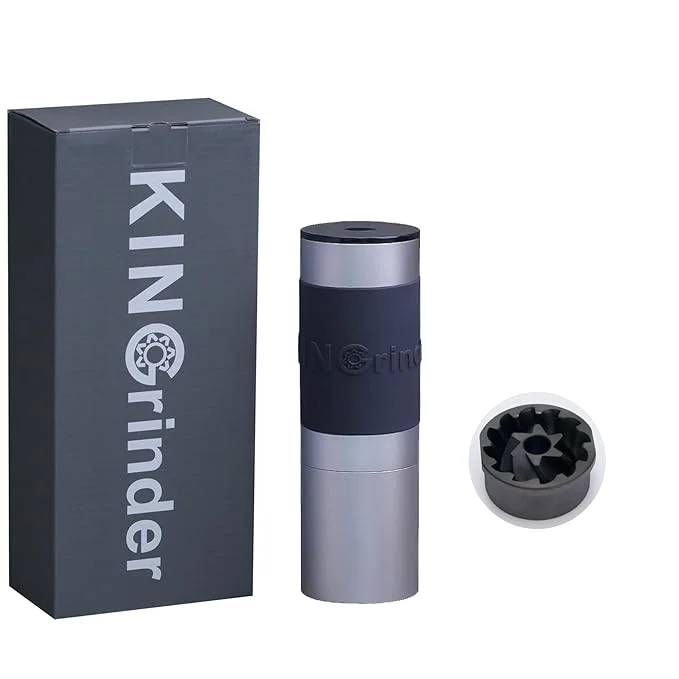
The K3 sits in an interesting position within the K-series lineup. According to KINGrinder's own comparison page, the K3 shares its burr geometry with the K2 and K4, but adds a titanium coating to the 48mm conical steel burrs.
In practice, that means particle distribution and flavour profile are functionally identical to the K2 at most settings, with the coating primarily extending burr lifespan rather than changing the cup.
Our long-form test of the K-series confirmed the shared geometry across the K2, K3 and K4, noting that the six-pointed burr design produced the same coffee across all three during the review window.
For espresso specifically, the K3 performs well within its price bracket. The 48mm burrs are large for a hand grinder at this price, and the stepped internal adjustment (40 clicks per rotation, per KINGrinder) offers enough resolution to dial in a competent shot with medium and dark roasts.
Light roasts are where it begins to struggle. The stepped mechanism lacks the fine, repeatable micro-adjustments that a single-origin light espresso demands, and the grind tends towards the sweeter, fuller-bodied end of the spectrum — pleasant, but not a clarity champion.
Build Quality
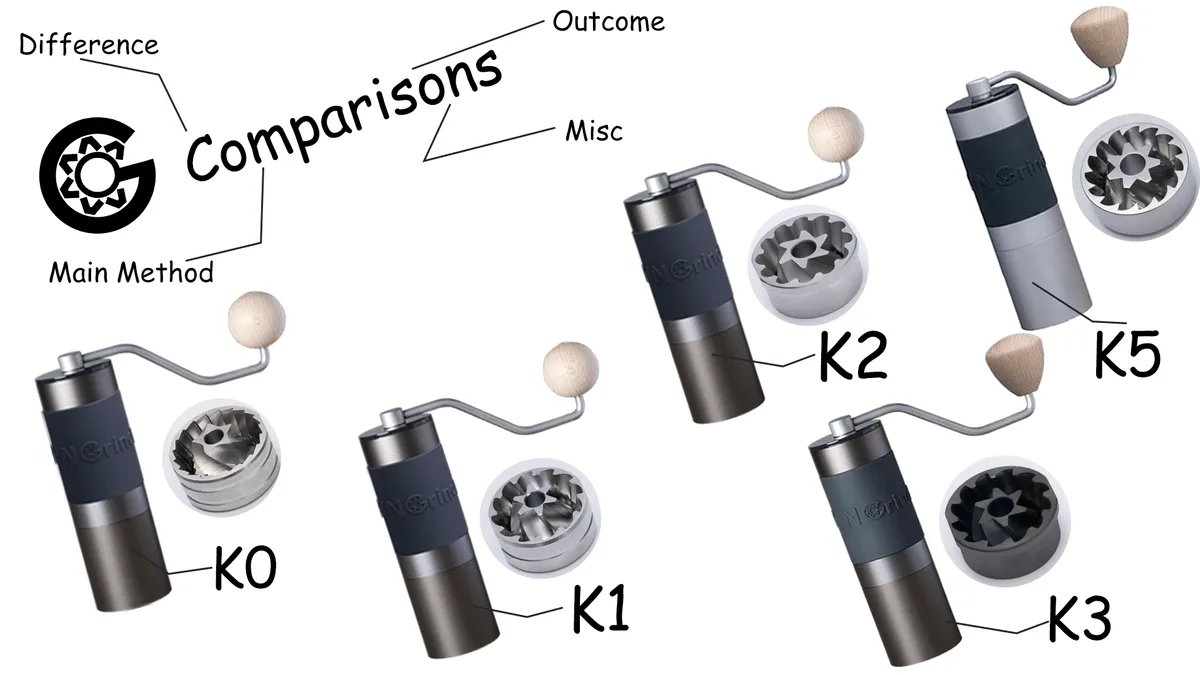
At 480 grams, the K3 is light enough to pack for travel but heavy enough to feel substantial on the counter. The body uses a conical-ball form factor that KINGrinder introduced to differentiate it from the older circular-ball designs on the K0–K2.
Construction is functional rather than premium: there's no anti-static treatment, so expect some retention and static cling, particularly in dry conditions. The handle has a wide rubber grip and an offset design that reduces wrist strain, a detail that matters more than it sounds when you're cranking out 20g doses for a double shot.
The titanium coating on the burrs is the real durability play. KINGrinder positions the K3 as the "affordable version of the K4," and the coating should meaningfully extend service life compared to uncoated stainless steel.
This is the kind of spec that's hard to quantify in a review, but it tracks with how the manufacturer markets the grinder and with the general industry understanding of titanium nitride coatings.
Workflow
Single-dose is where the K3 makes sense. The hopper holds 25 grams, which is just enough for a typical espresso dose with a little headroom. Internal adjustment is the workflow compromise here. To change grind size, you need to remove the inner burr, which is the same process as the K2.
It's not difficult, but it breaks the flow. If you switch between brew methods several times a day, you'll notice. If you find your setting once and stick with it, you'll forget about it.
Grinding effort is moderate. The 48mm burrs are 10mm larger than the P-series, which translates to noticeably easier turning. The K2 was "a much nicer grinder to hold" compared to smaller P-series models, and the K3 inherits that ergonomics.
You won't mistake it for an electric grinder, but a single dose is well within a minute of cranking for most users. RDT (a quick spritz of water on the beans) is recommended to tame the static, since the grinder has no built-in anti-static feature.
Who It's For
The K3 is aimed squarely at the budget espresso drinker who wants a capable hand grinder without crossing the $100 line. At $70–$95, it undercuts most of its 48mm conical competitors while delivering similar grind quality.
If you drink medium to dark espresso, pull shots on a manual or semi-automatic machine, and don't need to swap brew methods between pours, the K3 is a sensible buy. The K0 is the entry-level pick in the lineup; the K1 offers a similar form factor at a lower burr size.
If you want external adjustment and more versatility, the K4 or K5 step up, but they also step up in price.
How It Compares
Against the 1Zpresso K-Ultra, the K3 is cheaper but lacks the ULTRA's external adjustment and finer step resolution. The K3 makes sense if you'd rather save $40–$60 and don't mind the internal adjustment workflow.
Against its own siblings, the K3 is the espresso specialist: better suited to medium-dark shots than the more versatile K5, and better built than the entry-level K0, but otherwise nearly identical in grind output to the cheaper K2. The titanium coating is the differentiator, and it's a longevity play rather than a flavour play.
The Kingrinder K3 is a strong pick for budget-conscious espresso drinkers who pull medium to dark roasts and don't need to switch brew methods frequently. The 48mm titanium-coated burrs deliver solid grind quality, and the price undercuts most 48mm conical competitors. Skip it if you want external adjustment, light-roast clarity, or an anti-static workflow — in those cases, the K4, K5, or a 1Zpresso model will serve you better.
Hassan is a software developer with a coffee problem. Coffee Grinder Index is his attempt to solve it — one grinder at a time.