Kingrinder K1 Review
Budget espresso-capable hand grinder with internal adjustment. Can achieve espresso fineness but requires patience.
What We Love
Room for Improvement
Technical Specifications
| Weight | 400g |
| Bean Capacity | 20g |
Grind Quality
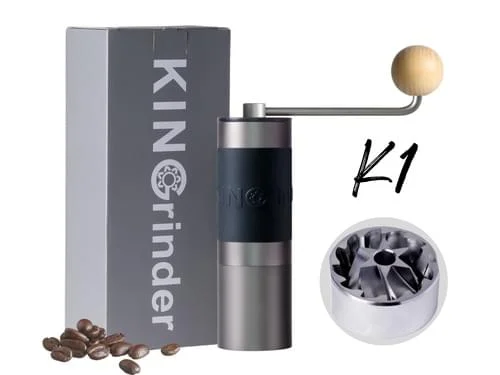
At the heart of the K1 sits a 38 mm conical steel burr set, the same family of burrs used across the K-series.
For a sub-$70 hand grinder, the cup is genuinely surprising: pour-overs come out clean and reasonably sweet, and the grinder is capable of true espresso fineness once you've found a setting that works for your bean. The catch is the adjustment system.
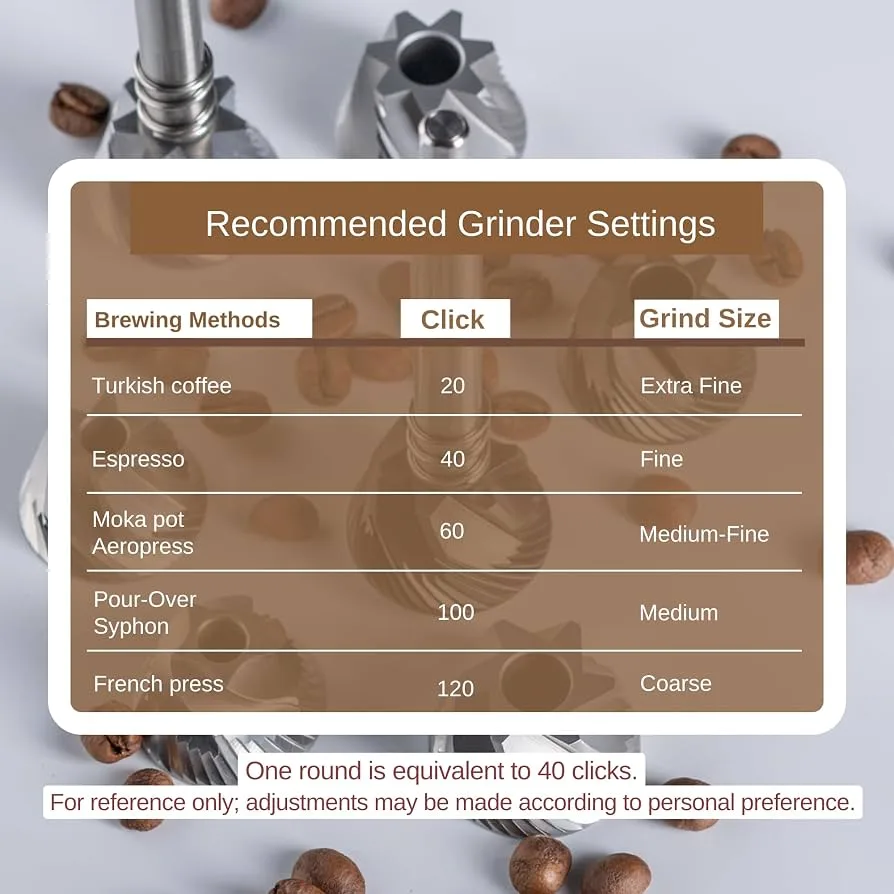
With 40 clicks per revolution at 18 microns per step, the steps are wide enough that you may get only one or two viable espresso settings per bag of beans, so dialing in is slower and more fiddly than on a 48 mm grinder with a finer-pitched collar.
The smaller burrs also produce a less uniform particle distribution than KINGrinder's larger offerings.
For someone stepping up from a blade or an entry-level electric burr grinder, the difference is night and day.
For someone chasing the clarity of a 48 mm flat or the K6, it is not.
Build Quality
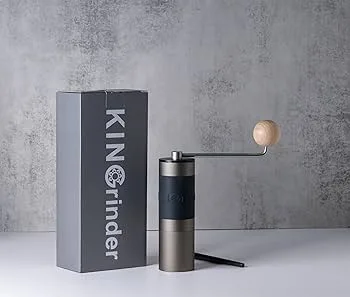
The body is aluminum, the burrs are stainless steel, and the axle runs on a dual-bearing design that KINGrinder highlights across the line. At roughly 580 g in the straight-handle configuration, it feels solid in the hand without being a desk anchor.
The circle-ball styling shared with the K0 and K2 is clean and unfussy, and the internal adjustment is a single rotating collar accessed by removing the handle assembly.
The Amazon listing at $77 mentions a 580 g shipping weight, which is a little heavier than the 400 g figure KINGrinder sometimes quotes for the bare grinder, but either way it is firmly in the portable-but-not-featherweight category.
There is no anti-static treatment, so expect some retention and a light static charge on the grounds chute after extended grinding, particularly in dry winter air.
Workflow in Daily Use
This is a single-dose grinder with a 20 g hopper, and the workflow is built around that. Load, grind, dose, repeat. There is no hopper, no grounds bin, no dosing funnel, and no external adjustment collar.
You set the grind by unscrewing the top, twisting the inner burr carrier, counting clicks against the printed ring, and reassembling. It is not difficult, but it is not quick either, and if you switch between espresso and filter regularly the dial-in ritual gets old fast.
Grind time is the other friction point. With 38 mm conical burrs, expect roughly 60 to 90 seconds for a double-espresso dose, versus the 35 to 45 seconds a 48 mm burr set will deliver. For a single morning espresso it is tolerable.
For back-to-back drinks or a pour-over for two, it starts to feel like a workout. Owners have reported success running the handle with a power drill for larger doses, which is a genuinely useful trick at this price.
Who It Suits
The K1 is a thoughtful first serious grinder for someone who already owns a pressurized basket portafilter or a basic espresso machine and wants to escape the tyranny of pre-ground coffee.
It is also a credible travel companion: light enough to pack, tough enough to survive a suitcase, and capable enough that you do not feel like you are punishing yourself for leaving the big grinder at home.
It is less convincing as a daily workhorse for someone who drinks three or four espressos a morning, or for someone who splits time evenly between light-roast pour-overs and espresso. In the latter case, the small burrs and stepped adjustment conspire to make every drink a dialing-in session.
How It Compares
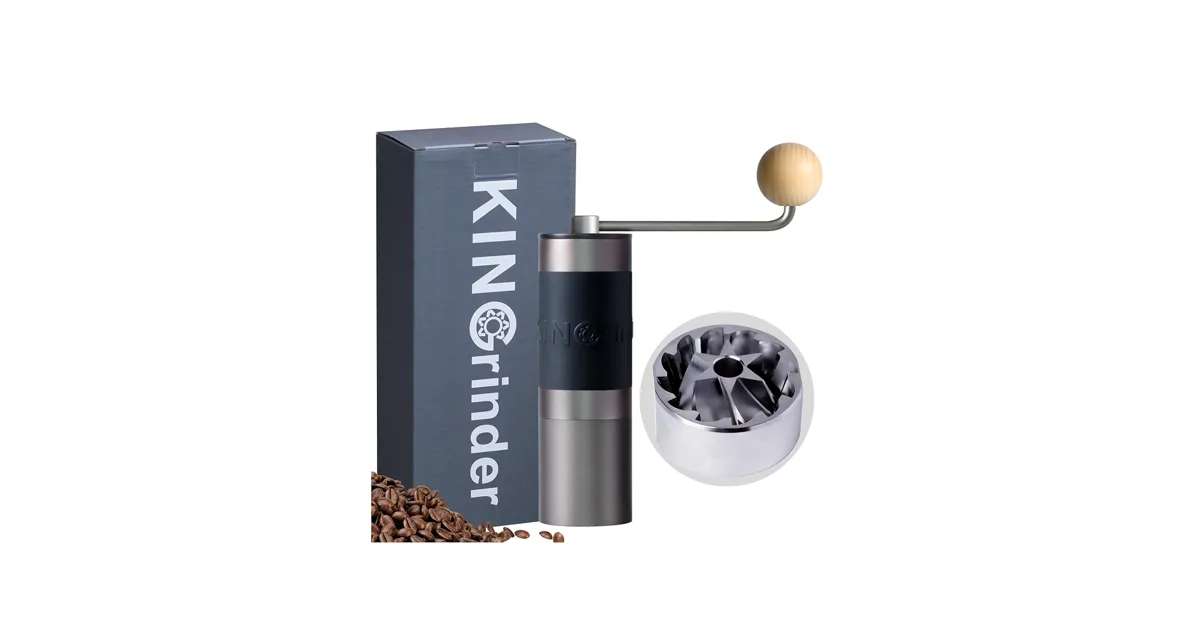
Within KINGrinder's own lineup, the obvious step up is the K6, which we have reviewed separately and which uses 48 mm heptagonal burrs and an external adjustment collar for noticeably faster grinding and finer pitch.
The Kingrinder K0 sits below the K1 as a beginner model with a smaller burr; the K1 is the right place to start if you want espresso capability without stepping up to the K4 or K6 price bracket.
Against the wider market, the 1Zpresso Q-Air is the closest competitor in spirit: a sub-$100 conical hand grinder aimed at travel and espresso. The Hario Skerton Pro lives in the same budget neighborhood but uses a ceramic burr set and cannot realistically pull espresso.
The K1 beats the Hario on grind quality and build, and trades blows with the Q-Air depending on which generation of Q-Air you find in stock.
The Honest Trade-Offs
What you are paying for with the K1 is the burr set, the dual-bearing axle, and a real conical grinding experience at a price most enthusiasts can justify on a first purchase. What you are not paying for is speed, fine adjustment resolution, or anti-static engineering.
Knowing which side of that trade-off matters more to you is the entire buying decision.
The K1 is the right pick for a budget-first buyer stepping up from a blade or entry-level electric grinder, particularly someone who drinks one or two espressos a day and values a portable, low-cost entry into real conical burrs. It is not the right pick for someone who pulls multiple shots back-to-back, splits time between espresso and light-roast pour-overs, or wants the kind of fine adjustment pitch that makes dialing in feel effortless. Spend more on the K6 if any of those apply.
Hassan is a software developer with a coffee problem. Coffee Grinder Index is his attempt to solve it — one grinder at a time.