Niche Zero Review
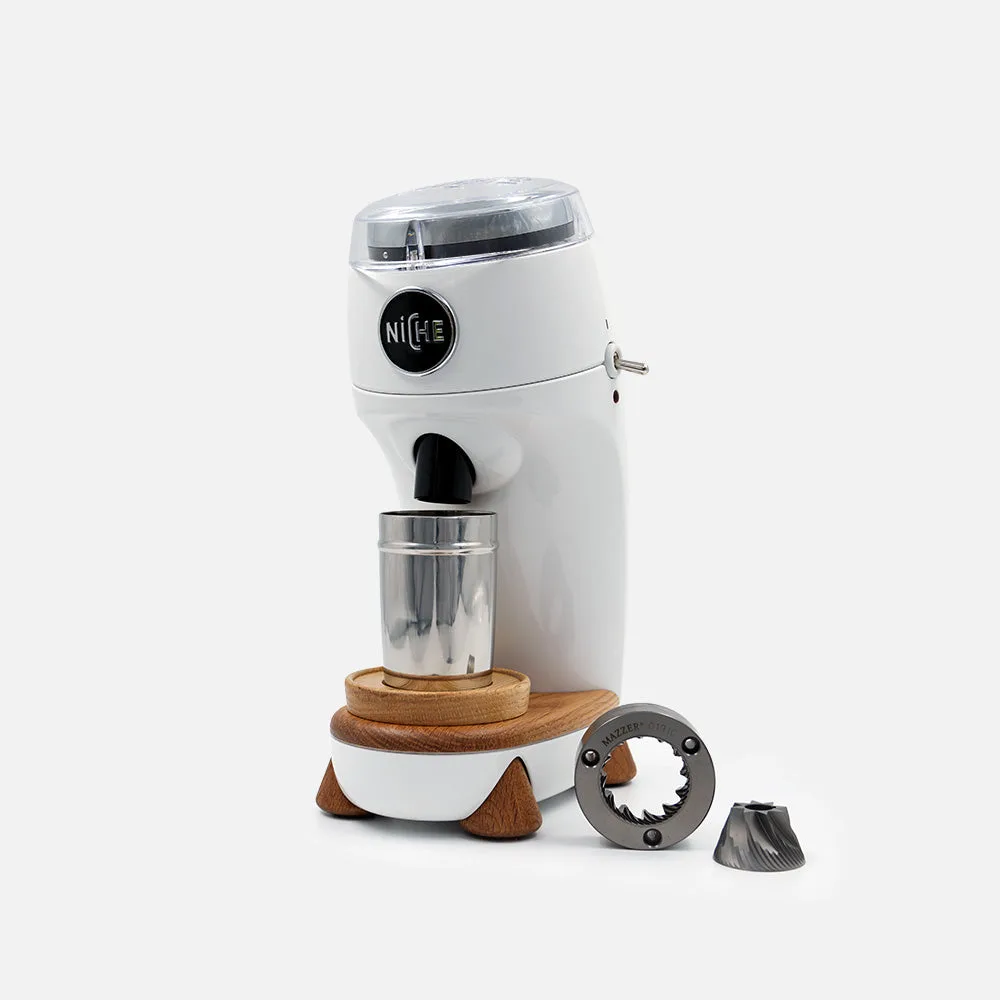
Started the single-dose revolution. 63mm Mazzer conical burrs.
What We Love
Room for Improvement
Technical Specifications
| RPM | Fixed 330 |
| Retention | <0.1g |
| Motor Power | 150W |
| Weight | 8200g |
| Bean Capacity | 50g |
Grind Quality
The 63mm Mazzer conical burrs are the headline, and they earn the attention. These are the same burrs Niche sources from Mazzer for the Kony, a workhorse commercial grinder, and at this price point the pedigree is unusual. Particle distribution favours a traditional espresso profile: syrupy, chocolate-leaning, full-bodied.
That is exactly what most home baristas want from a flat-bottomed portafilter, and it is what the Zero delivers shot after shot.
There is a real ceiling here, and anyone who has read the forums knows what it is. The conical geometry and the relatively low 330 RPM pull clearly defined cup notes, but they do not excavate the sparkling, translucent clarity that flat burrs or larger conicals at 1500+ RPM can produce.
Light-roast single origins can read a little muddy. For medium and dark roasts, and for the milk-driven drinks most owners actually pull, this is a non-issue.
Build and Design
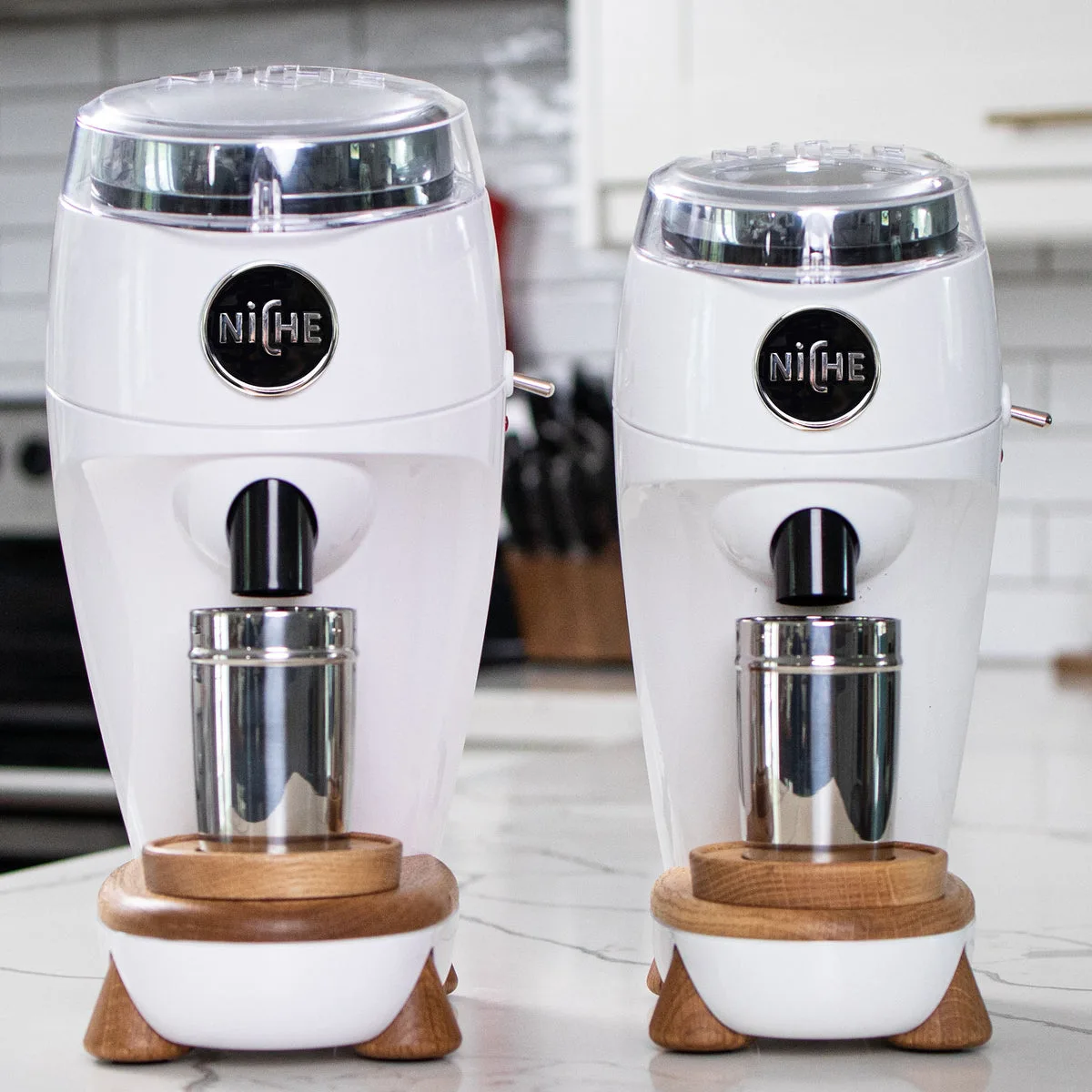
At 8.2kg in a 122mm-wide aluminium body, the Zero feels more like a small commercial unit than a kitchen appliance.
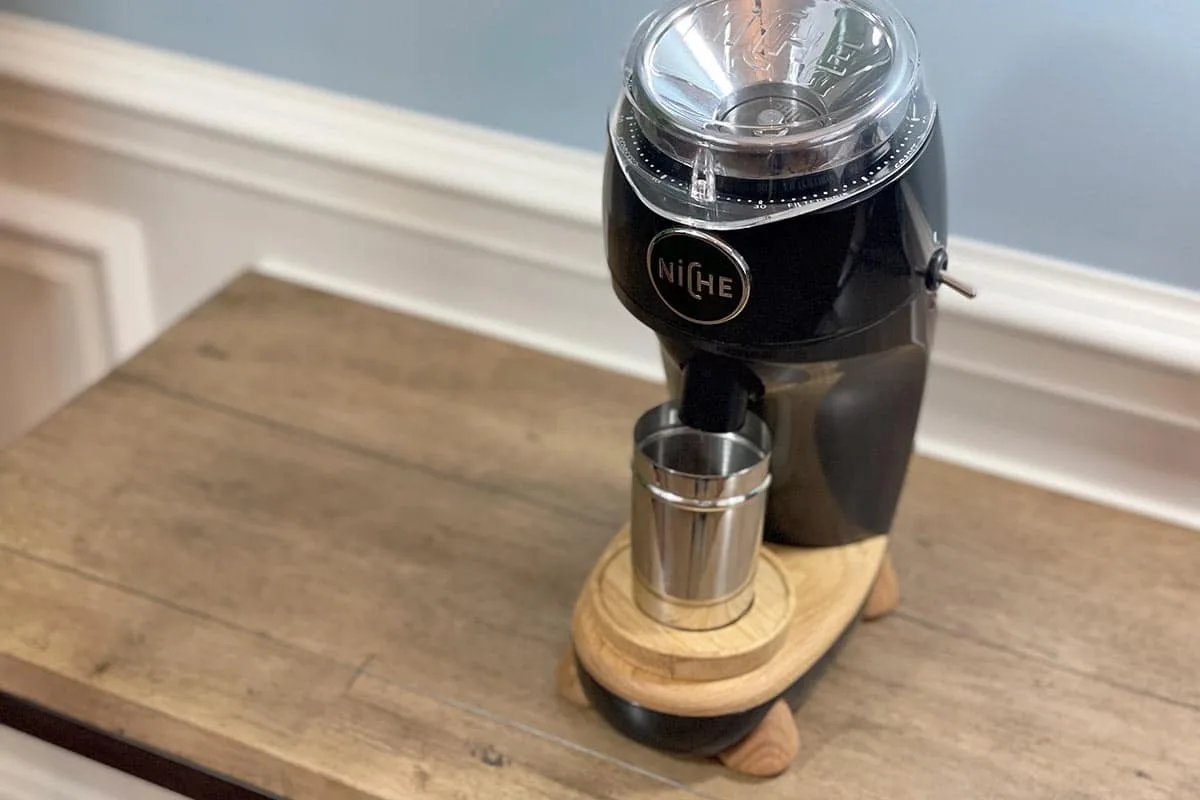
Cast aluminium body, real oak collar and feet, minimal protrusions, a magnetic lid that doubles as a safety switch and a guard for the stepless adjustment collar.
The stepless collar itself is one of the better implementations at this price. Adjustment is smooth, repeatable, and well-calibrated for dialling in espresso. There is no anti-pop or anti-static system, which is conspicuous on the spec sheet, but in practice static is mild enough that a few taps of the lid clear the chute.
Niche reportedly optimised the grind path geometry to manage this without an ioniser, and it shows.
Workflow in Daily Use
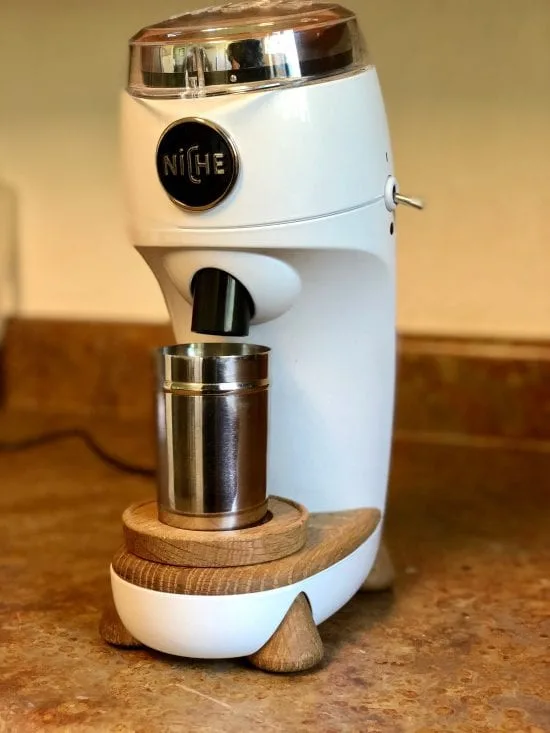
This is the grinder's defining strength. Single-dose is not a feature here; it is the entire design philosophy. There is no hopper, no bellows, no RDT routine required. Weigh beans, drop them in, flick the switch, grind, tap the lid, done.
The fixed-speed 150W motor is quiet by grinder standards, and the absence of a clumpy chute means you can dose directly into a portafilter without a mess.
Retention is genuinely under 0.1g, which is what made the Zero famous in the first place. Switching between beans is trivial; nothing carries over from the previous shot.
Against modern rivals like the Eureka Mignon Zero or the Eureka Oro Mignon Single Dose, the workflow is broadly comparable, but Niche got there years earlier and the polish is evident in the details.
Speed and Capacity
The 50g bean capacity is sized for one to two doses at a time, which matches the single-dose ethos but does mean batching is impractical. At 330 RPM, the 150W motor is not slow exactly, but it is not fast either.
Reviews consistently cite roughly one gram per second, so an 18g espresso dose takes around 18 seconds. That is fine for one or two morning shots, but anyone serving a group will find the wait tedious, and the existing entry's note about long wait times is fair.
Who It Suits
The Zero was designed for one user: a home barista who pulls one or two shots at a time, often switches beans, values a clean workflow, and does not want to mod or fuss with a grinder to get it working. Out of the box, that is exactly what you get.
There is no firmware, no burr swaps, no popper to assemble. It just works.
It does not suit everyone. If you want flat-burr clarity, the Niche Duo is the obvious step up from the same brand. If you want something cheaper to mod, the DF64 generation still offers a customisation path the Zero deliberately avoids.
And if budget matters, the Mazzer Mini and similar commercial-style hoppered grinders can be found for less, with the trade-off of worse workflow and higher retention.
Verdict on Value
At $600 to $700, the Zero is no longer the obvious value play it was at launch. Tariffs and currency shifts have pushed the US price close to the £559 UK figure cited by Balance Coffee, and the spec sheet has not changed while the competition has caught up.
What you are paying for is build quality, refinement, and a workflow that still sets the benchmark. That is worth real money, but the margin between the Zero and a capable single-dose flat-burr grinder has narrowed considerably.
Buy the Niche Zero if you pull one or two espresso shots at a time, switch beans often, and want a polished, mod-free single-dose workflow with proven conical burrs. Skip it if you want flat-burr clarity for light roasts, need to batch drinks quickly, or would rather spend the money on a flat-burr alternative like the Niche Duo. The premium still buys refinement, but it no longer buys class-leading value.
Hassan is a software developer with a coffee problem. Coffee Grinder Index is his attempt to solve it — one grinder at a time.