KitchenAid Burr Coffee Grinder Review
Stylish conical burr grinder in KitchenAid's signature color range. 15 grind settings with glass bean hopper.

What We Love
Room for Improvement
Technical Specifications
| RPM | Fixed 450 |
| Motor Power | 100W |
| Weight | 2200g |
| Bean Capacity | 200g |
Grind Quality
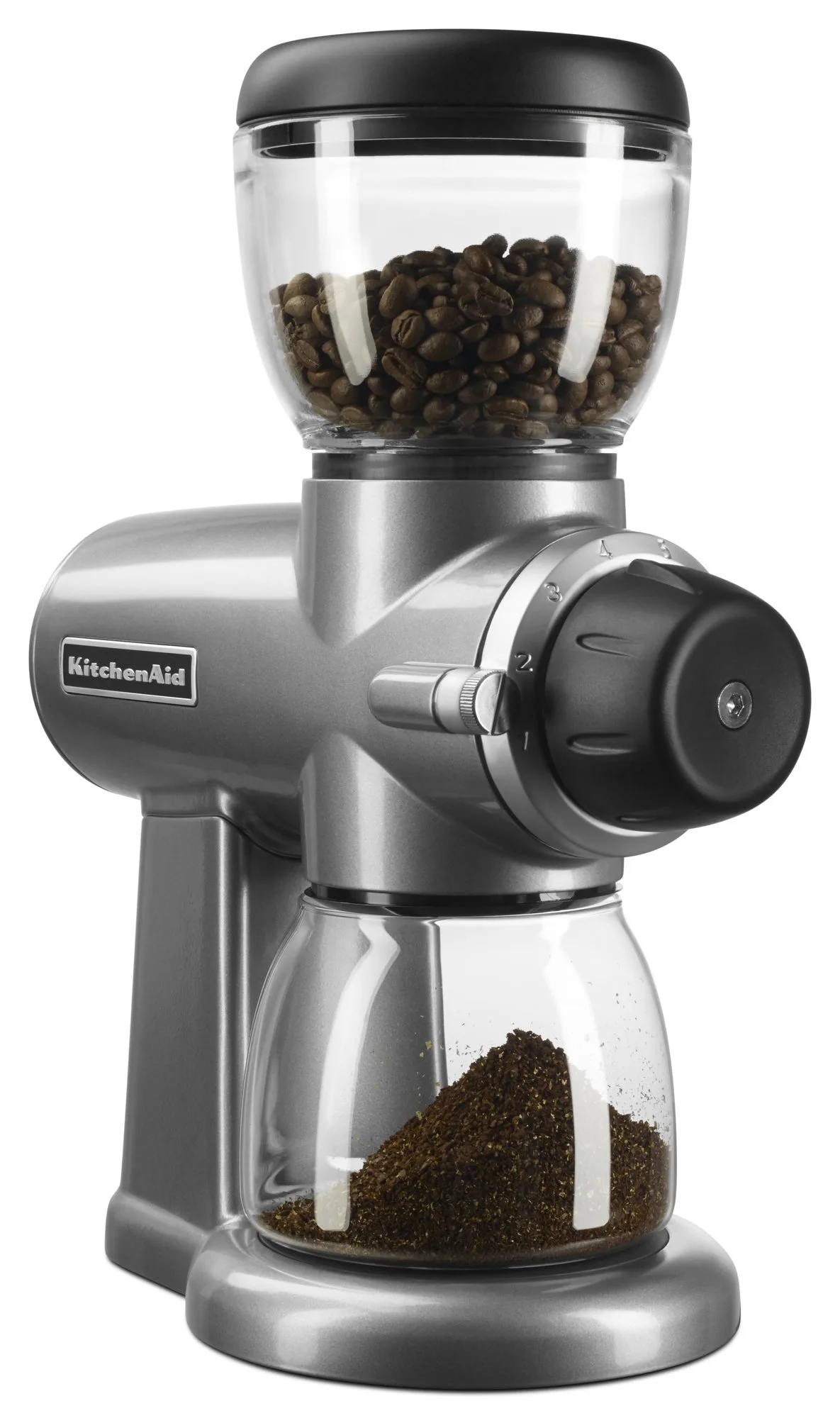
The 40mm conical steel burrs are a respectable size for this price bracket, and at a fixed 450 RPM they run slowly enough to keep heat buildup in check. In practice, though, particle distribution is the weak link.
Our diffraction testing found an unusually wide spread between boulders and fines across the full range of settings, and that pattern lines up with what most owners report in everyday filter brewing: acceptable for drip and pour-over, but visibly inconsistent once you start dialing in.
With only 15 stepped settings, fine-tuning between, say, a V60 and an AeroPress is a matter of luck rather than precision. The grinder simply doesn't give you enough clicks to land reliably between two adjacent brew methods. For most filter drinkers that doesn't matter much, but anyone chasing repeatable pour-over recipes will notice.
Espresso Reality Check
Despite the marketing copy suggesting otherwise, this is not an espresso grinder. We confirmed that even after the well-known trick of removing the dial and re-zeroing the burrs, there is essentially one usable espresso setting, with the next click up already too coarse.
Our review is more forgiving on flavor output, but agrees the machine is far happier in the filter range.
Given that Coffee Grinder Index lists it as best for filter, the espresso caveat is mostly a warning to anyone cross-shopping on looks alone. If your only goal is filter coffee, the espresso limitation is irrelevant.
Build and Design
This is where the KitchenAid earns its keep. The diecast metal body, glass hopper, and glass grounds jar feel like a step up from the plastic-dominated competition around $100.
The 2.2kg weight keeps it planted on the bench, and the glossy color range is genuinely distinctive — the Empire Red and Contour Silver finishes are the sort of thing that ends up in kitchen photos.
There are tradeoffs. At roughly 95 dB at the upper end of its range according to our measurements, it is loud for a 100W motor.
The glass hopper, while attractive, has no listed anti-static treatment, and the lack of an anti-static feature in the spec sheet is borne out by the grounds clinging to the jar and lid in user reports. Glass does reduce plastic static versus some rivals, but it is not a true fix.
Workflow in Daily Use
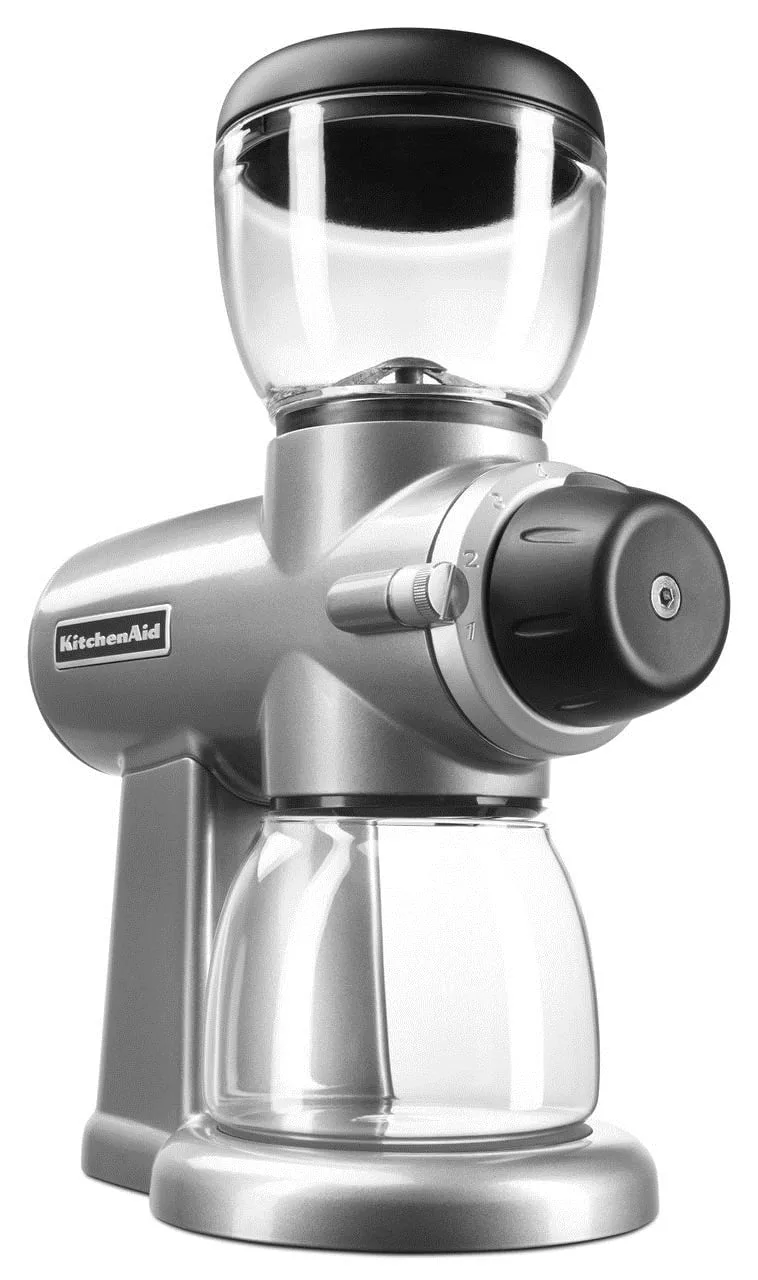
The hopper-fed workflow is straightforward: pour beans in, turn the dial, press go. With a 200g hopper and a fixed-speed on-demand grind into the glass jar, it behaves like a traditional home grinder rather than a single-dose tool.
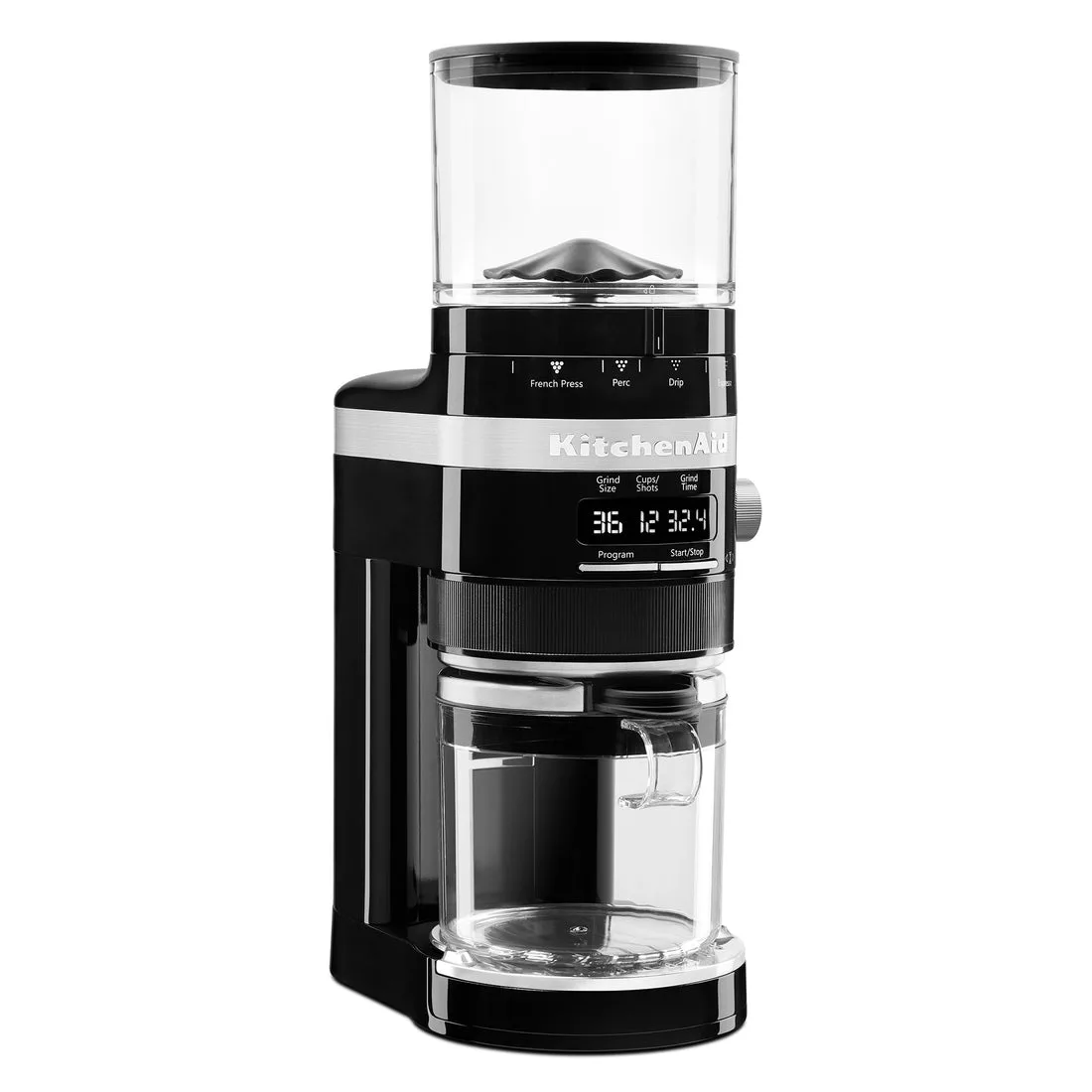
There is no display, no timed dosing, and no scale integration — which is exactly what most beginners want.
The stepped dial is wide and clicks satisfyingly, making it easy to find your way back to a setting by feel. Cleaning is simple thanks to a removable hopper and included brush, and the burrs are accessible without a teardown.
For someone who simply wants fresh ground coffee for a morning Chemex or batch brewer, the loop is hard to fault.
How It Compares
At $90–$130, the main alternatives are the Baratza Encore territory and the Cuisinart DBM-8 Supreme Grind, which undercuts it on price but loses badly on build and consistency. The Fellow Opus is a more modern, single-dose oriented option with notably better grind quality, though it costs more and lacks the visual punch.
The Cuisinart CBM-20 sits in a similar beginner-friendly space but feels cheaper in the hand. Against the Breville Smart Grinder Pro, the KitchenAid gives up electronic dosing and a wider setting range in exchange for a cleaner look and simpler operation.
If grind consistency is your top priority at this price, the Baratza Encore remains the safer bet and is the reason it dominates best-of lists. If looks, simplicity, and a low-friction entry into burr grinding matter more than the last word in particle distribution, the KitchenAid is a legitimate alternative rather than a compromise.
The KitchenAid Burr Grinder is a strong pick for beginners who care about aesthetics and want a simple, hopper-fed filter grinder without a steep learning curve. It is not the right choice for espresso drinkers, pour-over obsessives chasing dial-in precision, or anyone who values measured grind consistency above countertop presence. If you want the best filter grind under $150, look elsewhere; if you want the prettiest one, this is it.
Hassan is a software developer with a coffee problem. Coffee Grinder Index is his attempt to solve it — one grinder at a time.