Eureka Mignon Libra Review
Grind-by-weight perfection. 55mm flat burrs with an integrated load cell that doses precisely into your portafilter.
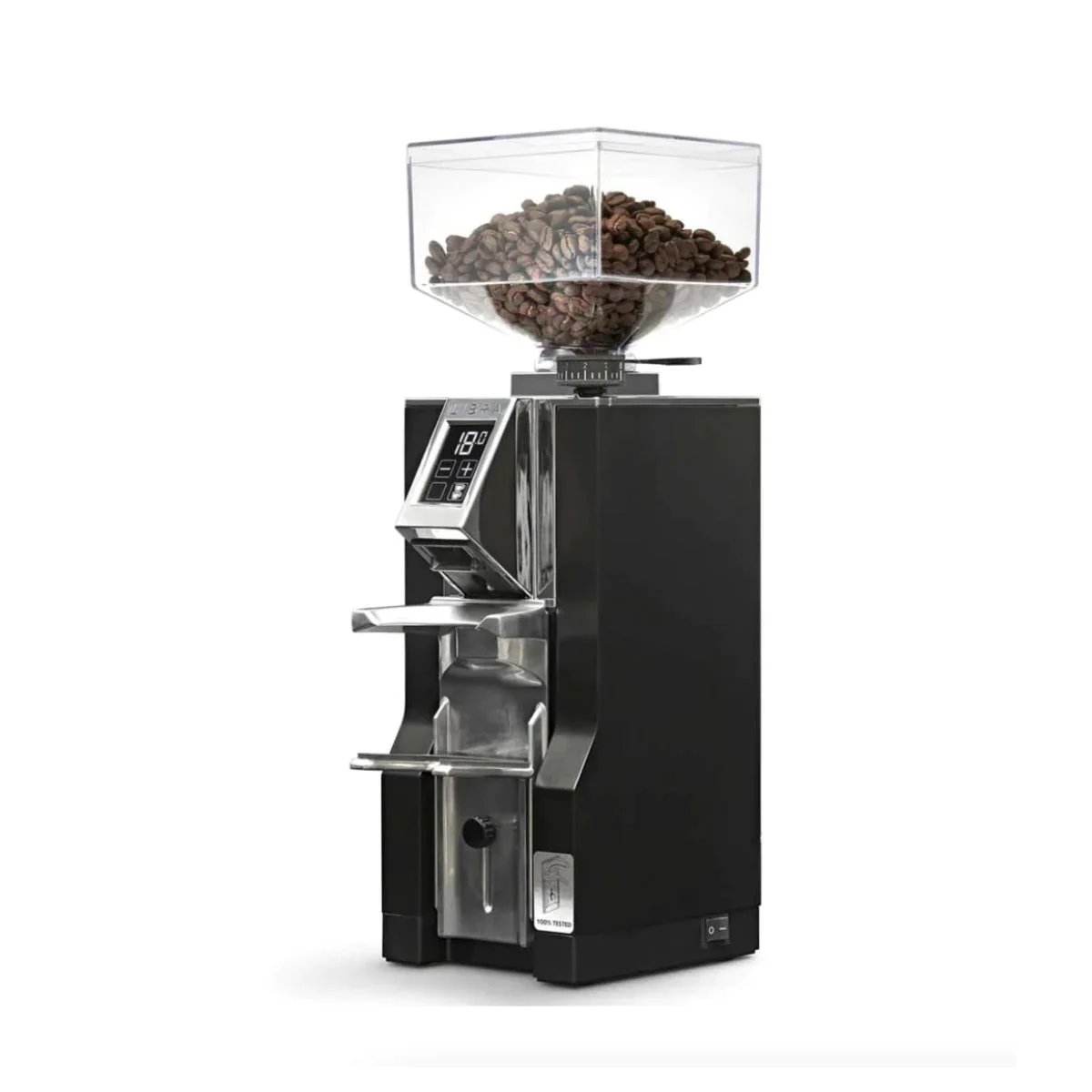
What We Love
Room for Improvement
Technical Specifications
| RPM | Fixed 1350 |
| Retention | <0.2g |
| Motor Power | 310W |
| Noise Level | 55 dB |
| Weight | 6200g |
| Bean Capacity | 300g |
Grind Quality
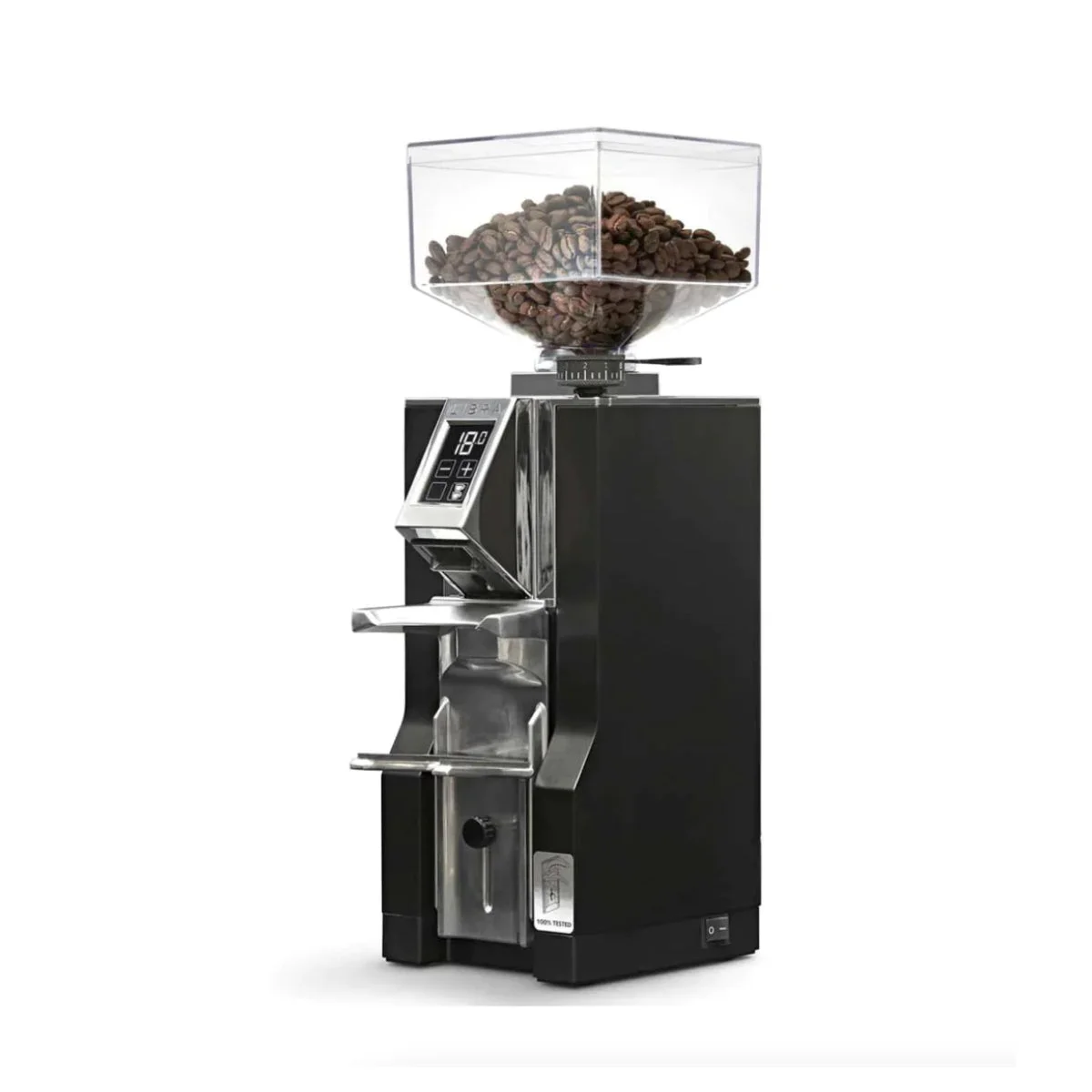
Flat hardened steel burrs at 55mm is a proven combination for espresso, and the Libra puts that geometry to work at a fixed 1350 RPM.
That's on the slower end of the flat-burr home category, and it shows in the cup: shots pull with a sweetness and body that owners consistently compare favourably to the Niche Zero it so often replaces.
The micrometric stepless collar is well-implemented, with enough travel and detent-free movement to dial in precisely across a wide range of roasts.
One caveat: 55mm flat burrs at 1350 RPM will be a poor match for anything coarser than a tight moka pot grind. If you occasionally want a credible V60 or French press, look at the Eureka Mignon Facile or consider a dedicated filter grinder.
The Libra is honest about what it is — an espresso specialist.
Build Quality
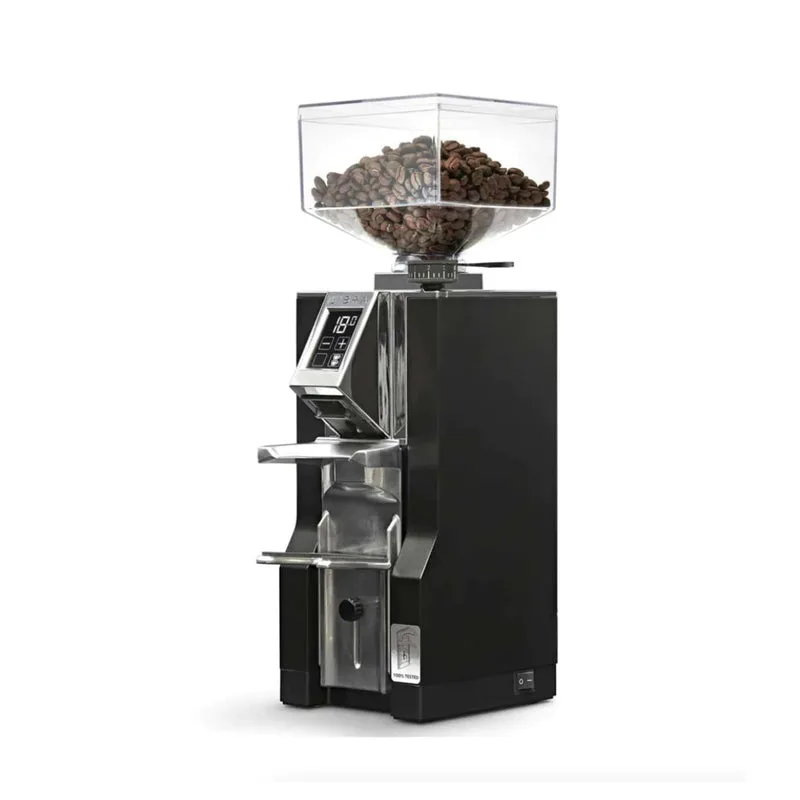
Italian manufacture shows in the fit and finish. The die-cast aluminium body has the reassuring density of 6.2kg, and nothing on the unit rattles or flexes. The hopper seats firmly, the grind adjustment dial turns with a satisfying resistance, and the portafilter fork is metal rather than plastic — a meaningful upgrade from earlier Mignons.
The integrated load cell is the part that lives or dies on build quality, and here Eureka has done the engineering properly. Independent testing shows the Libra lands within roughly ±0.1g of the target dose, which is the difference between a feature and a gimmick.
The trade-off is serviceability: if the scale ever drifts or fails, this is not a part the user can swap out.
Workflow in Daily Use
This is the grinder's reason for existing. You load the hopper, slot the portafilter onto the fork, select a dose, and the Libra grinds, weighs, and stops itself. The elimination of the weigh-grind-weigh-re-grind loop is transformative if you make more than one or two espressos a day.
For someone pulling four or five milk drinks in a morning, the time saved is real, not theoretical.
There are two practical wrinkles. First, the fork is designed around 58mm portafilters and the included dosing funnel; lighter 58mm bottomless portafilters can vibrate off the rest during grinding, so a heavier handle or the magnetic fork upgrade is worth budgeting for.
Second, because the chute is not designed to be cleared with a bellows, retention is genuinely low at under 0.2g — but switching beans between shots still means a quick purge, so the grind-by-weight advantage is biggest for people who commit to a single bag per session.
Who It Suits
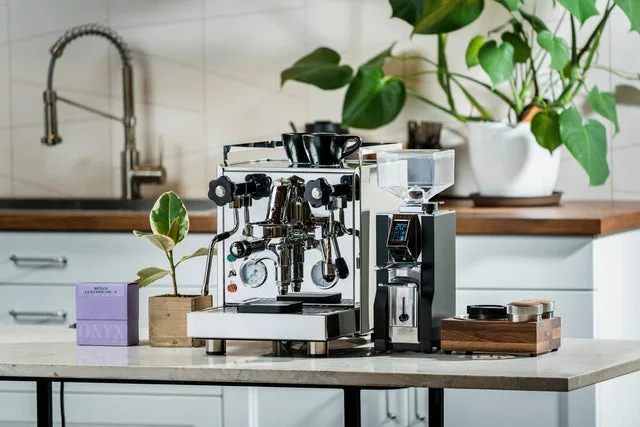
The Libra is built for the home barista who has already settled on a machine they trust and wants to remove the most error-prone step from their routine. It suits someone pulling two to five espressos a day, switching beans every week or two rather than every shot, and who values repeatability over exploration.
It is less suited to the curious dial-mover who wants to A/B grind settings constantly, since the absence of a bellows makes each change a little slower. The 55dB noise figure is plausible for a 310-watt motor under load, and it sits comfortably under a cupboard without dominating a kitchen.
The Baratza Sette 270Wi is the obvious cross-shop if grind-by-weight on a budget matters more than flat-burr clarity, though it concedes some cup quality to get there.
Value and Verdict
At $750–$800, the Libra sits in an awkward middle ground: well above entry-level Mignons, and brushing against commercial-adjacent machines like the Ceado E37S. What you are paying for is the integration of a reliable grind-by-weight system into a compact, well-built home package.
For a buyer who would otherwise pair a Niche Zero with a separate scale, the Libra is a sensible consolidation.
Anti-static performance is the one spec that disappoints on paper, though in practice the chute design and the dosing funnel contain most of the mess. The grinder does what it claims, and the dose accuracy holds up to scrutiny.
The Eureka Mignon Libra is for the home barista who pulls multiple espressos a day and wants grind-by-weight accuracy without stepping up to a commercial machine. It is a poor choice for anyone wanting a single grinder to cover filter coffee as well as espresso, and the fixed 58mm-centric fork is a nuisance with lightweight bottomless portafilters. Buy it for workflow; skip it if versatility is the priority.
Hassan is a software developer with a coffee problem. Coffee Grinder Index is his attempt to solve it — one grinder at a time.